 Save
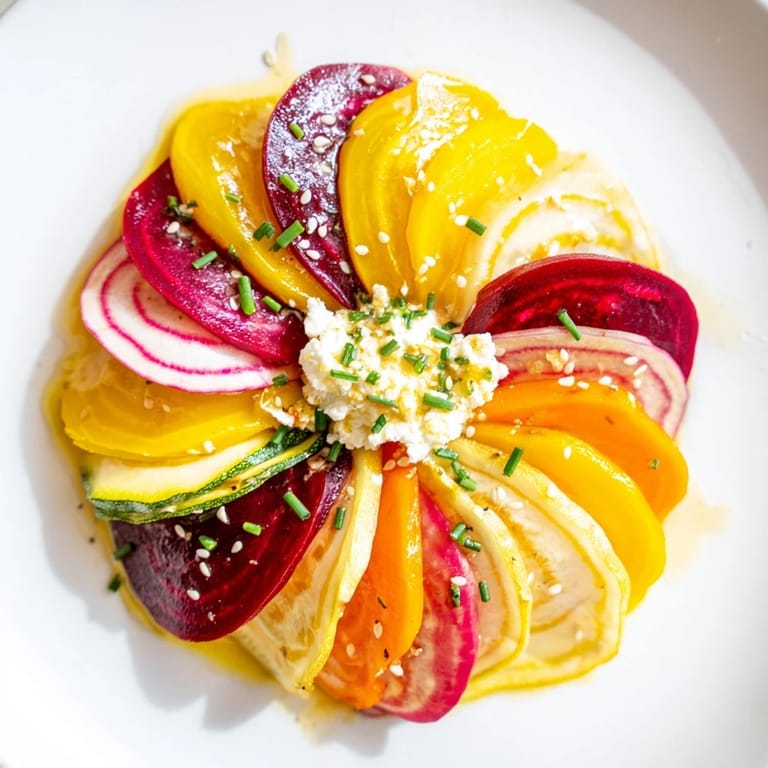
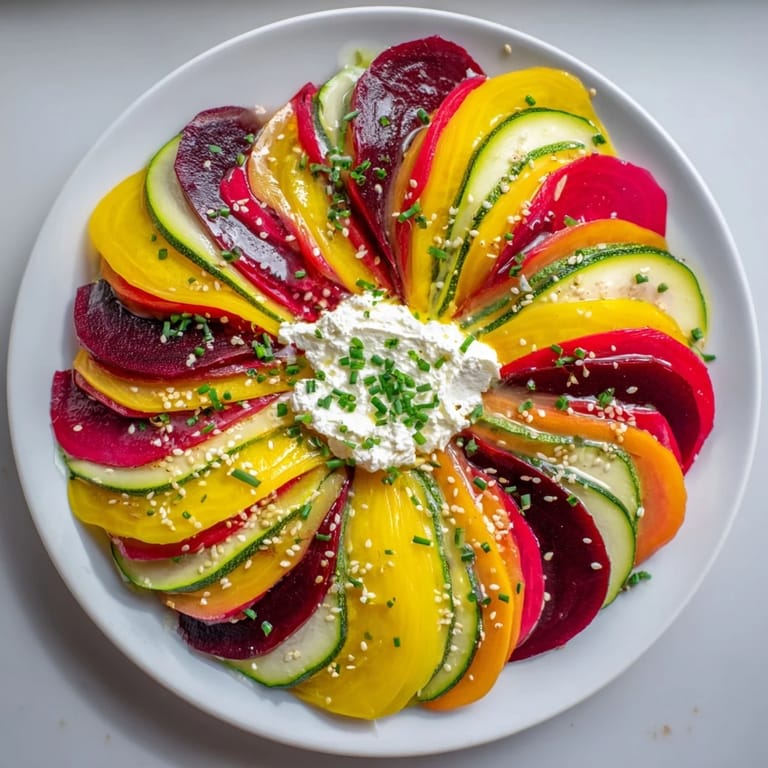
Save I'll never forget the afternoon I discovered that food didn't have to taste extraordinary to look unforgettable. I was arranging a simple platter of sliced vegetables for a dinner party, and something shifted when I decided to arrange them in radiating circles instead of haphazardly piling them on a plate. The golden beets, ruby reds, and sunny yellows suddenly became a work of art, and my guests gasped before they even tasted a bite. That's when I realized: sometimes the most memorable dishes are the ones that make people pause and simply admire before diving in.
I made this for my sister's birthday dinner, and I watched her face light up when she walked into the room. The sunburst pattern caught the evening light perfectly, and suddenly my kitchen felt like a fancy restaurant. She didn't want to disturb it at first, which meant everything to me—that moment when food becomes beautiful enough to hesitate before eating it.
Ingredients
- Golden and red beets: These are your color anchors. The golden ones are slightly sweeter and more delicate than red, so slice them last and keep them separate until arranging to prevent any bleeding. I learned to pat them dry with paper towels before slicing—it makes them fan out more gracefully.
- Zucchini and yellow squash: Choose firm, smaller specimens so your slices stay thin and delicate. The contrast between green and yellow creates that garden-fresh feeling that makes people say yes before tasting.
- Watermelon radish: This is your secret weapon. When you slice it, those gorgeous pink and white concentric circles appear like magic. It's almost too pretty to eat, which is exactly the point.
- Carrot: A good sharp peeler or mandoline transforms this into silky ribbons. The natural sweetness plays beautifully against the tangy dressing.
- Goat cheese and crème fraîche: This creamy center is essential—it's tangy enough to stand up to the vegetables but luxurious enough to feel indulgent. The crème fraîche keeps it spreadable and cloud-like.
- Extra-virgin olive oil, lemon juice, and honey: This simple dressing is a lesson in balance. The honey rounds out the lemon's sharpness and creates a glossy finish that catches light beautifully.
- Chives and sesame seeds: These add the final flourish—texture and a hint of nuttiness that reminds people this is a real dish, not just a pretty picture.
Tired of Takeout? 🥡
Get 10 meals you can make faster than delivery arrives. Seriously.
One email. No spam. Unsubscribe anytime.
Instructions
- Slice with intention:
- Get all your vegetables ready first, slicing each one as thin as you can manage. A mandoline is your friend here, but a sharp knife works beautifully too. As you slice, arrange each type on its own plate so you can see your color palette clearly. This is where you're building your composition.
- Mark your center:
- Place a small bowl or ramekin in the exact middle of your large round platter. This becomes your guide, your focal point, your sun. Step back and look at it from above—this perspective matters more than you'd think.
- Build the sunburst:
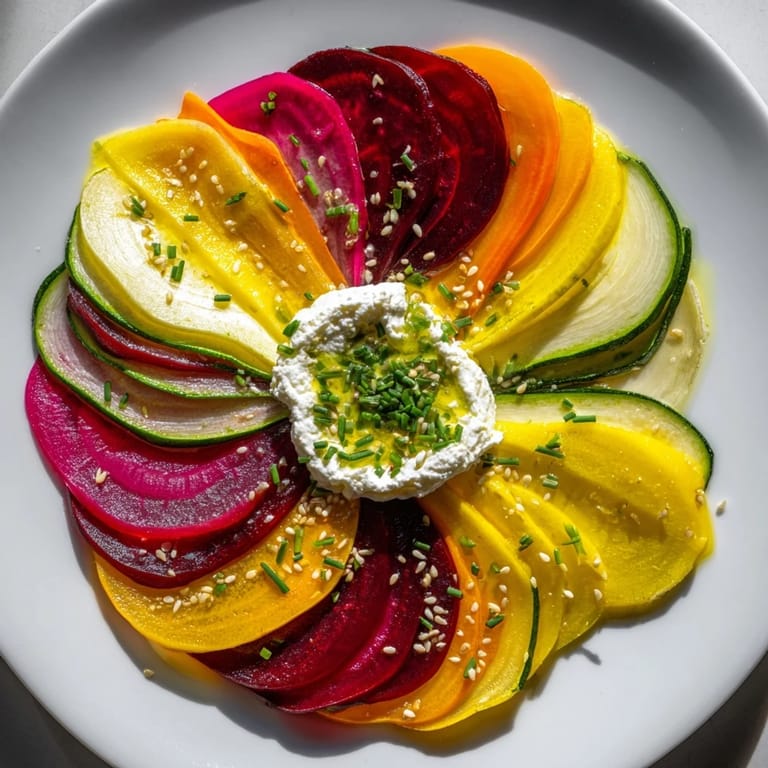
- Now comes the meditative part. Starting with one color, fan your slices outward from the center, overlapping each slice just slightly, like petals on a flower or rays of light. Then switch colors—golden beet next, then zucchini, then another beet. Work in concentric circles, keeping your pattern symmetrical. It's okay if it's not mathematically perfect; nature isn't either, and that's what makes it beautiful.
- Create the heart:
- Once your sunburst is complete, carefully lift away the center bowl. Mix your goat cheese with crème fraîche until it's smooth and spreadable, then fill that empty circle. Use the back of a spoon to create gentle swirls.
- Dress with care:
- Whisk your dressing together and drizzle it gently over the entire sunburst, letting some pool in the center. Use just enough to coat everything lightly—you want the vegetables to stay crisp, not swimmy.
- Crown your creation:
- Finish with a scattered handful of fresh chives and a sprinkle of toasted sesame seeds. If you have edible flowers, this is their moment to shine. Step back and admire what you've made.
 Save
Save My favorite memory with this dish happened when my picky eight-year-old nephew actually asked for seconds. He said it looked like the sun exploded on the plate in the best way possible, and suddenly vegetables weren't the enemy anymore. That's when I understood: sometimes feeding people is really about giving them permission to see their food as something worth loving.
The Art of Arrangement
Here's something that changed everything for me: the moment you stop thinking of this as a salad and start thinking of it as art, it becomes easier. You're not trying to perfectly arrange vegetables; you're creating a mandala, a sun, a moment of beauty. The slight imperfections—a slice that doesn't overlap quite right, a beet that's a millimeter thicker—these aren't failures. They're evidence that a human hand made this with care. Use a large platter, at least 12 inches across, so you have room to breathe with your arrangement. Circular platters work best, but a large square platter creates interesting geometry too.
Variations and Swaps
Once you understand the architecture of this dish, you can play with it endlessly. Cucumber slices add a cool, fresh element. Heirloom carrots in purple or white create unexpected color combinations. If you're not a goat cheese person, ricotta works beautifully—it's creamier and milder. Feta crumbles differently but brings a salty tang that's equally compelling. I've even swapped the sesame seeds for crispy chickpeas or crushed pistachios when I want nuttier flavors. The dressing is where you can get creative too: try balsamic instead of lemon, add a whisper of Dijon mustard, or drizzle with a white miso vinaigrette.
Timing and Serving
This is a dish that lives in the moment. You can slice your vegetables up to 4 hours ahead and store them separately in airtight containers, but the actual assembly should happen close to serving time—ideally within 30 minutes. The vegetables stay crisp and the goat cheese stays bright. If you're making this for a dinner party, arrange it on the platter just before guests arrive so the first thing they see is perfection. It serves 4 as a substantial appetizer or salad course, but if you're adding it to a larger spread, it stretches to feed 6 easily. Pair it with something crisp and white—a Sauvignon Blanc is perfect, but so is a crisp Pinot Grigio or even a light sparkling wine.
- Vegetables can be sliced up to 4 hours ahead and stored separately to prevent color transfer
- Assemble the entire sunburst no more than 30 minutes before serving to keep vegetables crisp
- The goat cheese mixture can be made an hour ahead and brought to room temperature just before filling the center
 Save
Save This recipe taught me that feeding people isn't always about complex techniques or fancy ingredients—sometimes it's about taking time to make something beautiful and inviting them to be part of that beauty. Every time someone walks away from this sunburst with a smile, you've done something right.
Recipe Questions
- → How should I slice the vegetables for the sunburst?
Use a sharp knife or mandoline to slice vegetables as thinly as possible for the best layering and visual effect.
- → Can I substitute the goat cheese?
Yes, ricotta or feta can be used as alternatives to goat cheese, offering different textures and flavors.
- → What is the purpose of the central bowl in the arrangement?
The bowl helps mark the focal point during arranging; removed after, it creates a perfect center for the cheese mixture.
- → How should the dressing be applied?
Whisk together olive oil, lemon juice, honey, salt, and pepper, then drizzle evenly over the arranged vegetables to enhance flavor without overpowering.
- → Are there garnish options to enhance presentation?
Fresh chives, toasted sesame seeds, and edible flowers add color, texture, and a subtle flavor boost to the dish.